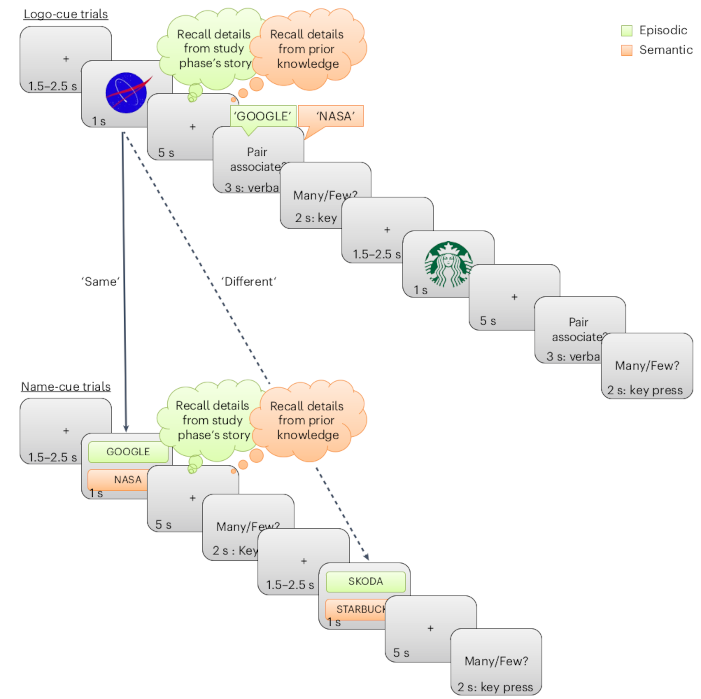
Abstract: Although the distinction between episodic and semantic memory is supported by numerous neuropsychological studies, neuroimaging data have shown considerable overlap between regions that are activated during semantic and episodic remembering. This might indicate similar or shared mechanisms but might also result from inadequate task designs or poor functional magnetic resonance imaging signal coverage. Here we compared neural activations and representations associated with successful retrieval of episodic and semantic memories, using tasks that are more closely matched. A total of n = 40 participants recalled pairings between logos and brand names, where the pairings corresponded to real-world knowledge (semantic task) or were learned in an initial study phase (episodic task). Neither a priori-defined networks nor clusters generally activated by our task provided evidence for any difference between successful semantic and episodic retrieval, with the Bayes factor for the a priori networks supporting the null hypothesis of no difference. Protocol registration The Stage 1 protocol for this Registered Report was accepted in principle on 15 September 2021. The protocol, as accepted by the journal, can be found at https://osf.io/dm47y/.
Tibon, R., Greve, A., Humphreys, G., Quent, J. A., & Henson, R. (2026). Neural activations and representations during episodic versus semantic memory retrieval. Nature Human Behaviour. https://doi.org/10.1038/s41562-025-02390-4 PDF
Comments