This is a placeholder page. I will post the .pdf as soon as it is live.
Leave a CommentJörn Alexander Quent Posts
Hippocampal subfields support human novelty detection via distinct signals Link: https://www.biorxiv.org/content/10.64898/2026.09.08.748144v1 Detecting novelty is fundamental to adaptive memory, yet the neural comparisons that allow new events to be distinguished from prior experience are not fully understood. Hippocampal novelty signals are often framed as associative comparator responses that register violations of learned relationships. However, recognition memory models also predict a broader form of comparison: a global, item-based mismatch between an incoming stimulus and aggregate memory traces. Whether such global matching is implemented within human hippocampal circuitry, and whether it contributes to memory decisions, remains unknown. Using ultra-high-field 7T fMRI during dense…
Leave a Comment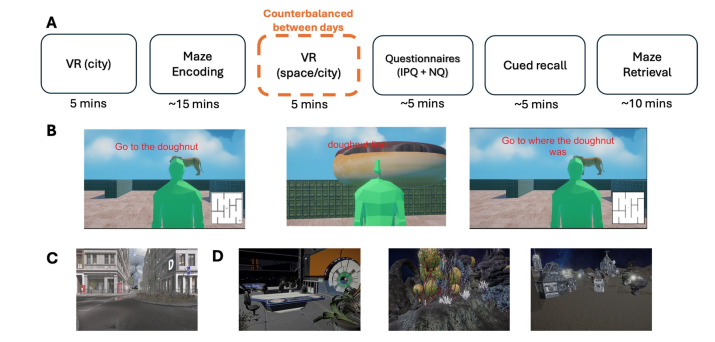
In our study, we investigated whether exploring a novel and unpredictable virtual reality environment could retroactively enhance spatial memory in humans, drawing inspiration from the robust behavioural tagging effects seen in rodents. Participants completed a two-day spatial memory task in virtual mazes, where object-location associations were learned under weak (single exposure) or strong (repeated exposure) encoding conditions. After encoding, they explored either a familiar, predictable city or a novel, unpredictable space environment featuring teleportation between distinct sites. Our key finding was a retroactive memory enhancement following novelty exposure but only when the novel environment was experienced on Day 2, after…
Leave a CommentI just posted a tutorial on creating publication-ready figures.
Leave a CommentAbstract: Although the distinction between episodic and semantic memory is supported by numerous neuropsychological studies, neuroimaging data have shown considerable overlap between regions that are activated during semantic and episodic remembering. This might indicate similar or shared mechanisms but might also result from inadequate task designs or poor functional magnetic resonance imaging signal coverage. Here we compared neural activations and representations associated with successful retrieval of episodic and semantic memories, using tasks that are more closely matched. A total of n = 40 participants recalled pairings between logos and brand names, where the pairings corresponded to real-world knowledge (semantic task) or were…
Leave a CommentAbstract: Successful navigation relies on the ability to process and encode detailed information about our dynamic environments. Beyond familiarity, emerging studies now highlight the crucial role of novelty detection in this process, the precise neural mechanism of which remains poorly understood. Using ultra-high field 7T fMRI, we investigated how the human brain encodes spatial novelty during virtual navigation, with a particular focus on graded representations that follow systematic transitions between novel and familiar spaces. Our results revealed novelty and familiarity specific neural responses within the posterior and anterior poles of the bilateral hippocampus, respectively. On the cortical surface, two separable…
Leave a CommentDownload link for the poster
Leave a Comment