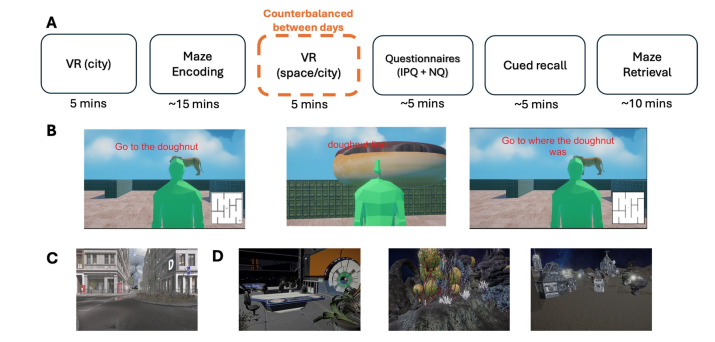
In our study, we investigated whether exploring a novel and unpredictable virtual reality environment could retroactively enhance spatial memory in humans, drawing inspiration from the robust behavioural tagging effects seen in rodents. Participants completed a two-day spatial memory task in virtual mazes, where object-location associations were learned under weak (single exposure) or strong (repeated exposure) encoding conditions. After encoding, they explored either a familiar, predictable city or a novel, unpredictable space environment featuring teleportation between distinct sites. Our key finding was a retroactive memory enhancement following novelty exposure but only when the novel environment was experienced on Day 2, after participants had already established a familiar reference point from the previous day’s sessions. This enhancement was evident across spatial accuracy, quadrant memory and cued recall of non-spatial associations, though it did not interact with encoding strength as classic behavioural tagging would predict. These results suggest that effective novelty-driven memory enhancement in humans may depend critically on having a prior reference point to evaluate what is truly novel and highlight the value of immersive, multi-dimensional novelty manipulations that better emulate rodent paradigms.
Janjua, A., Qin, Z., Quent, J. A., Lancia, G. L., Montaldi, D., & Frank, D. (2026). Probing Behavioural Tagging in Humans: Spatial Memory Reveals Novelty-driven Retroactive Enhancement. Journal of Cognitive Enhancement. https://doi.org/10.1007/s41465-026-00358-4 PDF
Comments